
Hybrid Denture vs Zirconia Full Arch: How to Choose the Final Prosthesis
By Stanislaw Gusinsky, Founder and Dental Technician, DreamWorks Dental Laboratories.
The hybrid denture vs zirconia question comes up on almost every full arch implant case we receive. Both are screw-retained, both replace an entire arch, and both start from the same records. They behave very differently over years of function, though. Getting the choice right comes down to the patient's bite, the opposing arch, the available space and how the prosthesis will be maintained. This guide sets out how we think about it at the bench, so you can prescribe with confidence and explain the trade-offs to your patient.
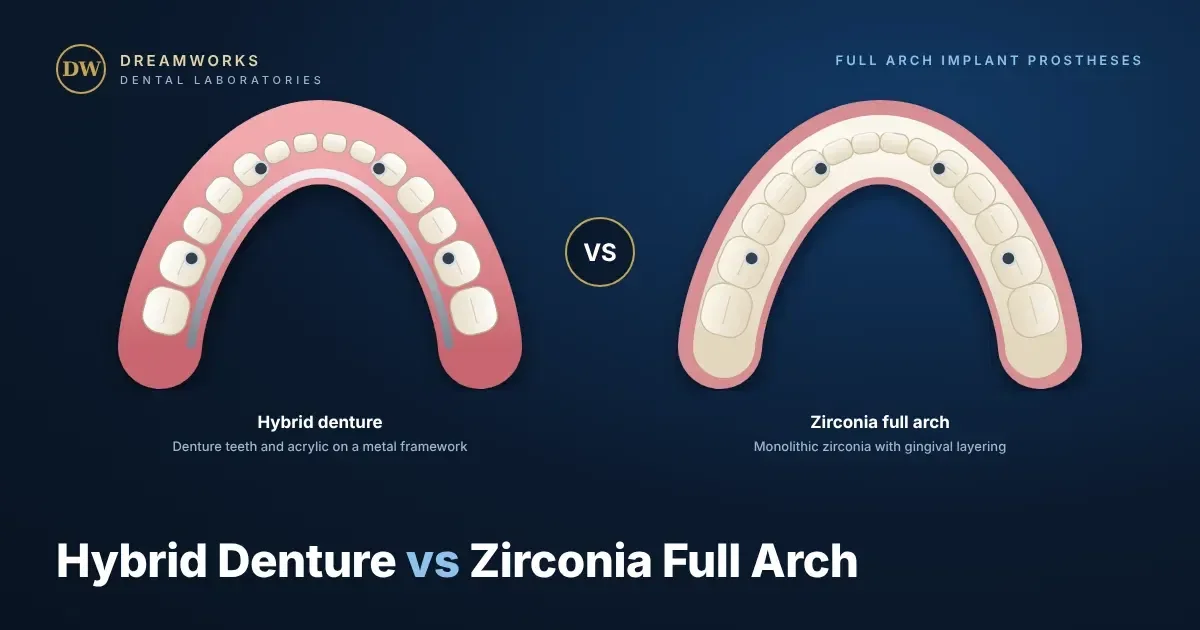
- A hybrid denture (metal-acrylic fixed prosthesis) uses denture teeth and pink acrylic on a metal framework. It is lighter, easier to repair, and usually the more economical option.
- A zirconia full arch is a monolithic or gingiva-layered zirconia prosthesis. It resists wear, staining and fracture far better, which is why it is our default for most patients.
- In long-term studies of metal-acrylic prostheses, veneer fracture and material wear are the most common complications. Short-term data on zirconia show a very low failure rate, with chipping mostly limited to veneered porcelain.
- Whichever you choose, prove the setup in a full arch fixed provisional first.
What Is a Hybrid Denture?
"Hybrid denture" is the common name for a fixed, implant-supported complete prosthesis made of denture teeth and pink acrylic resin processed over a rigid metal framework. You will also see it called a fixed hybrid denture, a metal-acrylic implant prosthesis or, in many All-on-4 and All-on-X cases, simply "the acrylic." It is screw-retained to multi-unit abutments, so the patient cannot remove it. Only the dentist can take it out for maintenance.
The design has a long track record and practical strengths. It is relatively light, acrylic is easy to adjust, and individual denture teeth can be replaced when they wear or chip. At DreamWorks, hybrid designs are built on titanium bases.
What Is a Zirconia Full Arch?
A zirconia full arch (also called a full arch zirconia bridge, zirconia denture or All-on-4 zirconia prosthesis) is milled from a single block of high-strength zirconia. It is either fully monolithic or monolithic with ceramic layered only on the gingival areas for esthetics. It is screw-retained to the implants in the same way as a hybrid, usually on titanium bases.
Monolithic zirconia is hard, dense and highly polishable. It does not wear down the way acrylic teeth do and it does not absorb stain or odor. With good design, it keeps its contours and shine for years. That is why it is our most common choice for the full arch fixed final.
Hybrid Denture vs Zirconia: Side-by-Side Comparison
| Factor | Hybrid denture (metal-acrylic) | Zirconia full arch |
|---|---|---|
| Materials | Denture teeth and pink acrylic over a metal framework | Monolithic zirconia, optionally with gingival ceramic layering |
| Wear resistance | Acrylic teeth wear over time, faster against natural teeth or ceramics | Very high; contours and occlusion stay stable |
| Most common complications | Tooth or veneer fracture, material wear, screw loosening | Chipping of veneered porcelain; full fracture is rare when connectors are well designed |
| Stain and odor | Acrylic is porous enough to discolor and collect plaque over time | Glazed or polished zirconia resists staining and plaque buildup |
| Weight | Lighter | Heavier, because zirconia is a much denser material |
| Repairs | Teeth and acrylic can be repaired or replaced | Minor chips can be polished chairside; a fracture means a remake (fast if the design file is kept) |
| Restorative space | Needs room for the framework, teeth and acrylic | Can work in less vertical space, but connector height is still critical |
| Relative lab fee | Usually lower | Usually higher |
| Best suited to | Patients who need a lighter prosthesis, easy repairs or a lower initial cost | Most patients, especially bruxers and those opposing natural teeth or another fixed arch |
What the Research Says
The evidence is not a perfect head-to-head comparison, but the pattern is consistent.
- Metal-acrylic hybrids: A meta-analysis of implant-supported fixed prostheses in edentulous patients followed for at least five years found that veneer fracture and material wear were the most frequent complications. Estimated cumulative veneer fracture rates were 30.6% at 5 years and 51.9% at 10 years (Bozini et al., 2011).
- Zirconia full arch: A systematic review of 285 one-piece zirconia fixed complete dentures reported a short-term failure rate of 1.4%. Most complications (14.7% of prostheses) were chipping of veneered porcelain. The authors suggest that monolithic zirconia with only gingival stain or layering may perform even better, though long-term studies are still needed (Bidra et al., 2017).
In practice, this matches what we see. Hybrid complications are usually minor and repairable, but they recur. Zirconia complications are less frequent, and most come from layered porcelain, which is why we keep layering to the gingival areas.
When a Hybrid Denture Is the Better Choice
- Lighter prosthesis needed: for example, when a lighter maxillary prosthesis is preferred.
- Easy chairside repairs are a priority: for a patient who may need adjustments, or where future changes are likely.
- Budget drives the decision: the lab fee is usually lower, and the patient understands the maintenance trade-off.
- Opposing complete denture: where the wear and load of an acrylic-on-acrylic occlusion are a reasonable match.
When a Zirconia Full Arch Is the Better Choice
- Bruxers and heavy biters: acrylic teeth wear and fracture quickly under parafunction.
- Opposing natural teeth or another fixed arch: polished monolithic zirconia holds its occlusion, where acrylic teeth flatten.
- Limited restorative space: monolithic zirconia can often work where a framework, teeth and acrylic will not fit. We confirm this on the scan before design.
- Patients who want low maintenance and lasting esthetics: zirconia keeps its polish and color.
Design Details That Matter More Than the Material
Longevity depends more on fit, occlusion, cantilever length and hygiene than on the material alone. Whichever material you prescribe, these are the details we check before anything is milled:
Passive fit
A full arch has to seat passively on every implant. We check the scan data for distortion before design and will ask for a verification step if implant positions look questionable.
Connector height and cantilevers
Zirconia needs adequate connector height, especially at the distal abutments, and both designs benefit from short cantilevers. If the records show a long cantilever or low connector height, we call before we fabricate.
Hygiene and maintenance
The intaglio surface is shaped convex and polished so patients can clean under it. Screw access holes are kept out of the esthetic zone wherever implant angulation allows. We also keep the design files, so a replacement can be made without starting from scratch.
Prove It in the Provisional First
We strongly recommend a fixed provisional before either final. The provisional tests tooth position, vertical dimension, lip support, phonetics and hygiene access in the mouth. Once the patient approves it, we carry those details into the final rather than designing from a setup the patient has never worn. See how we handle full arch provisionals for immediate-load cases. If the patient is coming from a conventional denture, we can use a scan of that existing denture as the starting point.
What to Send With a Full Arch Final
- Implant system and platform for each site
- Scans of the approved provisional in function
- Final scans with scan bodies, or a verified impression
- Tooth and gingival shade, plus full-face and smile photos
- Material preference (zirconia or hybrid), or ask us to recommend one
- Seat date, so we can schedule production
Not sure which to prescribe? Send the records and we will review the space, bite and opposing arch with you before we pick. You can submit a digital case online, call us at 561-235-2311, or contact our Delray Beach lab.
Frequently Asked Questions
Is a hybrid denture the same as an All-on-4?
Not exactly. All-on-4 describes a surgical approach that uses four implants to support a full arch. The prosthesis on those implants can be a hybrid denture (metal-acrylic) or a zirconia full arch.
How long does a hybrid denture last compared with zirconia?
Both can serve for many years, but hybrids usually need more maintenance along the way. Denture teeth wear and may need replacement, and veneer fracture becomes more common the longer the prosthesis is in function. Monolithic zirconia holds up very well when fit, occlusion and cantilevers are designed correctly.
Is zirconia better for bruxers?
In most cases, yes. Monolithic zirconia resists wear and fracture far better than acrylic teeth. Many clinicians also prescribe a night guard for heavy bruxers to protect the implants and the prosthesis.
Can a zirconia full arch be repaired?
Minor chips can often be polished chairside. A fracture usually means a remake. Because we keep the design file, a replacement can usually be milled without starting over.
Can you convert an existing hybrid denture to zirconia?
Often, yes. A scan of the existing prosthesis in function gives us a proven tooth setup to start from, as long as the implant records are current and accurate.
About the author
Stanislaw Gusinsky founded DreamWorks Dental Laboratories in Delray Beach, Florida, in 2021. A dental technician with more than 32 years of experience building and running dental laboratories in Israel, Russia, Canada and the United States, he focuses on implant restorations, full arch work and digital workflows. Learn more about our lab.
This article is written for dental professionals. Prosthesis selection is a clinical decision that stays with the treating dentist. Patients considering full arch implant treatment should discuss their options with their own dentist.
Blog Post Author

Contributed by DentalROI
DentalROI provides relevant dental content to help providers educate patients. The statements, services, and products referenced in this article have not been evaluated by the Food and Drug Administration, and they are not intended as a substitute for professional medical advice, diagnosis, or treatment. Always seek the advice of your dental provider with any questions or issues you may have. Specific recommendations may vary in different circumstances, so individual consultation is important.