
Flexible vs Cast Partial Dentures: How to Choose the Right RPD for Each Patient
By Stanislaw Gusinsky, Founder and Dental Technician, DreamWorks Dental Laboratories.
Choosing between flexible vs cast partial dentures is rarely about which material is "better." It is about which design suits the remaining teeth, the ridge and what the patient cares about most. Cast metal partials remain the workhorse for definitive removable partial dentures. Flexible partial dentures solve specific problems, mostly esthetic, and create others. This guide explains how each one works, where each fits, and what we need from you to build either one well.
Key takeaways
- Cast metal partial dentures (usually cobalt-chromium frameworks) are the most durable option, with thin, rigid connectors and tooth support through rests. They are also the easiest to reline, repair and add teeth to.
- Flexible partial dentures (thermoplastic nylon-type resins) have no metal clasps and blend with the gingiva. They are harder to adjust, reline and repair, and their color is less stable over time.
- The Japan Prosthodontic Society's position paper does not recommend flexible, metal-free clasp dentures as definitive prostheses except in limited cases such as metal allergy.
- Acrylic partials remain a practical choice for transitional or interim cases.
Types of Partial Dentures at a Glance
Most removable partial dentures fall into three groups:
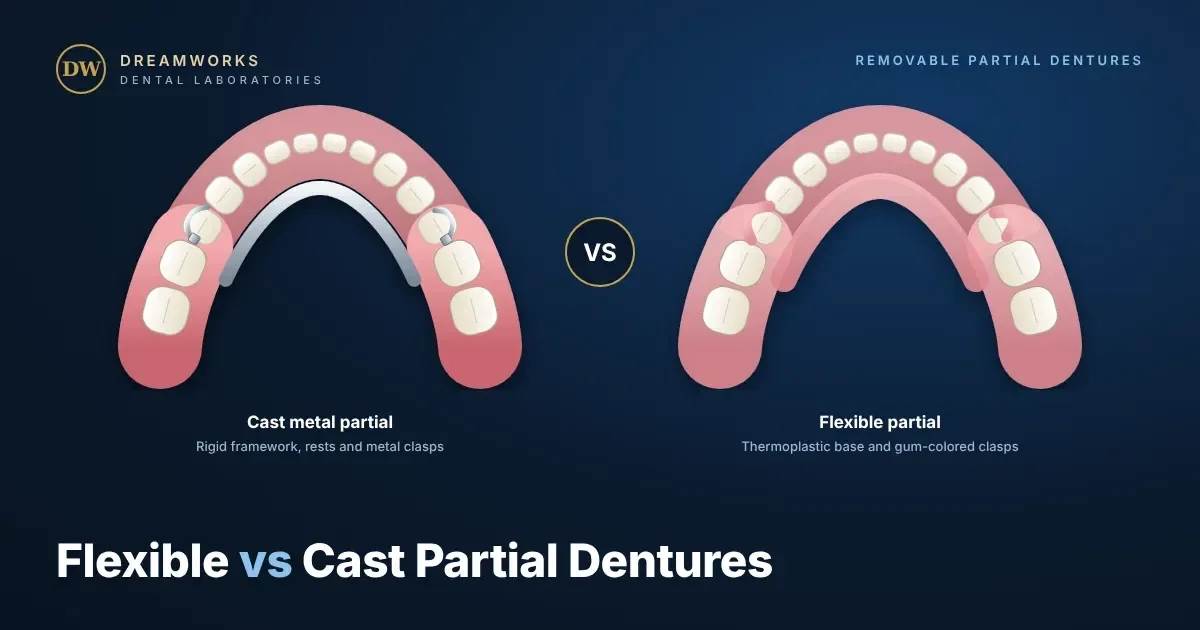
- Cast metal partial denture: a one-piece cast framework with a rigid major connector, rests, clasps and retention for acrylic bases and denture teeth.
- Flexible partial denture: a thermoplastic resin base with gingiva-colored clasps that engage undercuts, typically without a metal framework. Valplast is one of the best-known brand names for this type of material.
- Acrylic partial denture: a PMMA base with wrought wire clasps, mostly used as a transitional or interim appliance.
We make all three. See our partial and full dentures page for materials and options.
Flexible vs Cast Partial Dentures: Side-by-Side Comparison
| Factor | Cast metal partial | Flexible partial |
|---|---|---|
| Framework | Rigid cast metal with major connector | Thermoplastic resin base, usually no metal |
| Tooth support | Occlusal or cingulum rests direct load to the abutments | Usually mucosa-borne; little or no rigid rest support |
| Esthetics | Metal clasps may show | No visible metal; clasps blend with the gingiva |
| Thickness and rigidity | Thin metal connectors that stay rigid under load | Thin, light base, but flexible rather than rigid |
| Adjustment | Clasps can be adjusted; acrylic areas easy to trim | Hard to adjust and polish chairside |
| Reline and repair | Straightforward reline of acrylic bases; repairs routine | Difficult to reline or repair |
| Adding teeth later | Usually possible | Difficult; often means a new partial |
| Color stability | Metal stable; acrylic bases behave like standard dentures | Material can stain and discolor over time |
| Metal allergy | Not suitable if the patient is allergic to the alloy | A good option |
| Best suited to | Most definitive RPDs with healthy abutment teeth | Esthetic priorities, metal allergy, some interim cases |
What the Research Says
A position paper from the Japan Prosthodontic Society classed partial dentures that use thermoplastic resin clasps as "non-metal clasp dentures." It divided them into flexible types (no metal framework) and rigid types (with a metal framework). The panel did not recommend flexible non-metal clasp dentures as definitive prostheses, except in limited cases such as patients with a metal allergy. It also stated that these dentures should follow the same design principles as conventional clasp-retained RPDs (Fueki et al., 2014).
A 2024 literature review of flexible dentures describes the same balance. The materials offer good esthetics, a thin and light base, and an option for patients with metal or monomer allergy. They are also easily scratched, difficult to repair or reline, and less color-stable than conventional acrylic. The review lists metal or monomer allergy, restricted mouth opening, avoiding visible metal clasps, severe ridge undercuts, and temporary space maintenance as typical indications (Binaljadm, 2024).
When a Cast Metal Partial Is the Better Choice
- Definitive treatment with healthy abutments: rests and a rigid connector distribute load to the teeth, not just the soft tissue.
- Distal extension cases: rigid support and well-planned rests help control movement of the extension base.
- Patients likely to lose more teeth: a cast partial can usually have teeth added and bases relined as the mouth changes.
- Bilateral or long-span cases: a rigid major connector provides cross-arch stability that a flexible base cannot.
When a Flexible Partial Is the Better Choice
- Esthetics come first: the patient won't accept visible metal clasps, especially on anterior or premolar abutments.
- Metal allergy: a metal-free design removes the alloy entirely.
- Interim or space-maintaining partials: where a lightweight, comfortable appliance is needed for a limited time.
- Severe undercuts: where a rigid base would be hard to seat.
Before prescribing flexible, check that the patient understands the trade-offs. It may need replacing rather than relining as the ridge changes, and adding a tooth later is often not practical.
Design Principles Apply to Both
A flexible material does not change the biology. Whichever type you prescribe, the same planning rules apply.
Survey and design
For cast partials, we survey the model and design rests, clasps and connectors around the remaining teeth. If guide planes or rest seats would improve retention and stability, we send a design note before the framework is made.
Support and stability
Ask where the load is going. A partial that relies entirely on soft tissue will sink and move more than one which rests on sound abutments.
Try-in before processing
We set teeth to your records so you can check esthetics, speech and bite at try-in, before the partial is processed. Changes at try-in are quick; changes after processing are not.
What to Send for a Partial Denture
- Accurate impressions or scans of both arches
- A bite record
- Tooth shade and mold, or reference photos
- Partial type (cast metal, flexible or acrylic), or ask us to recommend one
- Which teeth you want clasped, or let us survey the model and propose a design
- Seat date, so we can schedule production
Not sure which partial to prescribe? Send the records and we will talk it through before we fabricate. You can submit a digital case online, call us at 561-235-2311, or contact our Delray Beach lab. If a patient is moving from a partial to fixed teeth on implants, see our full arch fixed provisionals.
Frequently Asked Questions
Can flexible partial dentures be relined?
It is difficult. Thermoplastic resins do not bond well with conventional reline materials, so many flexible partials are remade rather than relined when the ridge changes. Cast metal partials with acrylic bases are relined routinely.
How long do flexible partial dentures last?
It varies with the patient, the material and how well the partial is cared for. Flexible materials can stain and roughen over time, and they cannot easily be relined or added to. Many function well as interim prostheses, while cast metal partials are generally the longer-term option.
Can you add a tooth to a flexible partial denture?
Usually not easily. Adding a tooth to a thermoplastic base is often impractical, so a tooth loss often means a new partial. Cast metal partials can usually be added to.
Are flexible partial dentures more comfortable?
Many patients find them comfortable because they are light and have no metal clasps. Comfort also depends on fit and support. A well-designed cast partial with good rests can feel more stable during chewing.
Which is better for a patient with a metal allergy?
A flexible, metal-free partial is the usual choice when the patient has a confirmed allergy to the framework alloy.
About the author
Stanislaw Gusinsky founded DreamWorks Dental Laboratories in Delray Beach, Florida, in 2021. A dental technician with more than 32 years of experience building and running dental laboratories in Israel, Russia, Canada and the United States, he and his team fabricate fixed, implant and removable prosthetics for dentists nationwide. Learn more about our lab.
This article is written for dental professionals. Partial denture selection is a clinical decision that stays with the treating dentist. Patients should discuss their options with their own dentist.
Blog Post Author

Contributed by DentalROI
DentalROI provides relevant dental content to help providers educate patients. The statements, services, and products referenced in this article have not been evaluated by the Food and Drug Administration, and they are not intended as a substitute for professional medical advice, diagnosis, or treatment. Always seek the advice of your dental provider with any questions or issues you may have. Specific recommendations may vary in different circumstances, so individual consultation is important.